
Program Notes & Texts and Translations
The event is generously supported by the Consulate General of the Republic of Poland in Houston.
Program Notes
Polish Romanticism and Modernism (Young Poland) movements are deeply shaped by the country’s political history, particularly the loss of independence during the 19th century. Romanticism (1820s–1864) responded to this crisis through powerful ideas of national identity, portraying Poland as a spiritual “martyr nation” and emphasizing emotion, folklore, and the heroic struggle for freedom. Nature, imagination, and mysticism became central tools for preserving cultural identity in the absence of a state.
By the turn of the 20th century, the Young Poland movement (1890s–1918) revived these Romantic ideals in a more introspective and symbolic language. Artists embraced individual expression, psychological depth, and “art for art’s sake,” while continuing to draw on folk traditions and the natural world. In both periods, art served not only as aesthetic expression but as a form of cultural resistance, sustaining national spirit and identity until Poland regained independence in 1918.
Mieczysław Karłowicz (1876–1909)
Mieczysław Karłowicz is regarded as one of Poland’s most important late Romantic composers, best known for his symphonic poems and richly expressive orchestral music. His works combine lush sonorities with philosophical depth, exploring themes of fate, nature, love, and mortality. Influenced by composers such as Richard Strauss and Tchaikovsky, Karłowicz played a key role in shaping a distinctly Polish voice within European late Romanticism.
Earlier in his career, he composed a number of art songs (pieśni) - intimate, lyrical works that reveal a deeply personal and poetic sensibility before he turned primarily to large-scale orchestral forms. Beyond music, Karłowicz was also a passionate mountaineer and photographer. His life was tragically cut short at the age of 32 in an avalanche in the Tatra Mountains, contributing to his almost mythic artistic legacy.
Tonight’s program presents three contrasting early songs, forming an intimate emotional diary of the young composer.
“Z nową wiosną” (With the New Spring)
Cast as an effervescent waltz, the song juxtaposes the renewal of nature with the irreversibility of human emotion. Its delicate lyricism finds a visual parallel in images of spring by Polish painters such as Boznańska, Podkowiński, Malczewski, Pruszkowski, Witkiewicz, Mehoffer, and Makowski.
“Mów do mnie jeszcze” (Speak to Me Still)
Set to a poem by Kazimierz Przerwa-Tetmajer, this song reflects the sensibility of the Young Poland movement, expressing longing, emotional vulnerability, and the ache of unfulfilled love. Its intimate intensity resonates with works by Simmler, Wyczółkowski, Okuń, and Malczewski.
“Rdzawe liście” (Rusty Leaves)
This temperamental song embodies the Young Poland aesthetic of melancholic “sad love,” exploring themes of transience and emotional fragility. Its mood is echoed in paintings by Boznańska, Makowski, Malczewski, and Chełmoński.
Władysław Żeleński (1837-1921)
A cornerstone of 19th-century Polish musical life, Władysław Żeleński was a prolific composer and educator who championed the development of a national operatic and symphonic styles. Often seen as a successor to Stanisław Moniuszko, Poland’s foremost opera composer, Żeleński’s works are characterized by a refined Neo-Romantic language, melodic sophistication and a deep-seated lyricism.
Violin Sonata in F major, Op. 30: II. Allegretto
Composed in the early 1880s, the Violin Sonata represents Żeleński’s mastery of chamber music refinement. The second movement serves as a rather sophisticated stylized dance, however, while it is set in the formal structures of the sonata cycle, it is infused with the rhythmic vitality of Polish folk traditions. The movement prominently features the spirit of the Mazurka, which is defined by its triple meter and characteristic accents on the second or third beat. It showcases how Polish composers often used folk music idioms and character to assert a distinct national identity during the partitions.
Paired with paintings by Sichulski, Axentowicz,, Wodzinowski, Tetmajer. Gierymski, Chełmoński
Fryderyk Chopin (1810–1849)
Nocturne in F♯ Major, Op. 15 No. 2
This nocturne is one of Chopin’s most graceful and luminous early works, composed just before his departure from Poland. It radiates lightness, elegance, and refined lyricism, unfolding as a delicate, song-like melody shaped by the ideals of bel canto.
Étude in E Major, Op. 10 No. 3 (“Tristesse” / “Żal”)
Often referred to as “Tristesse” (Sadness) or “Żal” (Regret), this profoundly lyrical étude embodies deep nostalgia and homesickness. Composed around 1832, it reflects Chopin’s longing for his homeland following his move to Paris. While sometimes associated with the composer’s most cherished melody, the work is more accurately understood as a study in refined musical expression and technical control.
Its extraordinary cantabile quality has inspired numerous vocal transcriptions, treating the piano line as an almost operatic melody. In tonight’s version, its breath-like phrasing and lyrical intensity transform the work into a deeply personal lament, underscoring Chopin’s ability to evoke the human voice through the piano.
Paired with paintings by Ciągliński, Wyspiański, and Wyczółkowski.
“Kalina” (The Viburnum)
Music by Ignacy Komorowski (1824-1857) Lyrics by Teofil Lenartowicz
“Kalina” is a quintessential expression of Polish Romantic lyricism, weaving a poetic narrative of love and loss with the symbolism of the viburnum tree, an image often associated with a young woman whose life unfolds through joy, longing, and mourning. The composer of this song, Ignacy Komorowski, was a trained cellist, and often performed chamber music in Warsaw’s musical circles. “Kalina” remains his best known composition.
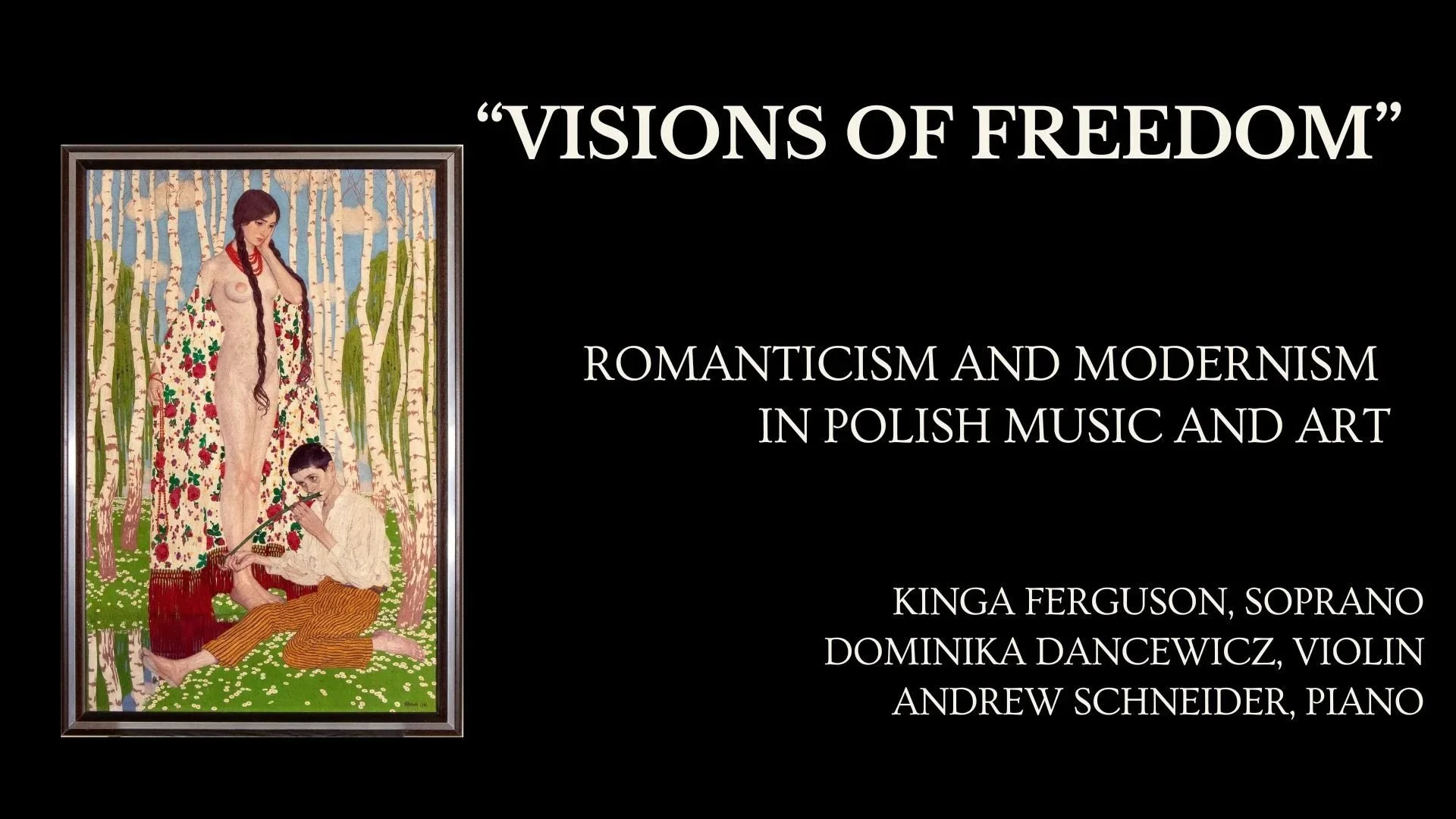
The song inspired a painting of the same title by Edward Okuń (1872-1945) who described it as a visual interpretation of Lenartowicz’s text. Through a refined Art Nouveau language, Okuń conveys the fragility and transience at the heart of the poem. Symbolic motifs - the red berries, viburnum leaves, and the female figure, evoke both the folkloric roots of the theme and its universal emotional resonance.
Created in 1918, the painting also carries a national dimension: the viburnum becomes a symbol of Poland reborn after years of partition, marked by suffering yet enduring in beauty and hope. Rather than illustrating the poem literally, Okuń evokes a mood of quiet unrest and reflective melancholy, embodying the spirit of the Young Poland movement.
Paired with paintings by Okuń, Malczewski, Kotsis, and Kossak.
Karol Szymanowski (1882–1937)
Karol Szymanowski is widely regarded as the father of Polish modernism. His career followed a fascinating trajectory, moving from early influences of Chopin and Strauss toward a lush, impressionistic style, and finally to a profound engagement with Polish folklore.
In the middle of his career, Szymanowski became deeply enamored with Mediterranean and Middle Eastern cultures. His travels to Sicily and North Africa sparked a creative obsession with the "Orient," which he viewed as a world of ecstatic beauty and mystery. This period culminated in his operatic masterpiece, King Roger.
“Roxana’s Song” (from opera King Roger, arr. by Paweł Kochański)
Originally an aria for the Queen in King Roger, this piece is a quintessential example of Szymanowski’s "orientalism." Through winding, chromatic melodies and shimmering harmonies, the music evokes the exoticism and sensuality that fascinated Polish artists of the era. Tonight’s performance parallels the visual themes found in Polish Orientalist painting (scenes of North African markets, odalisques, and Mediterranean landscapes) reflecting a broader European trend of looking to the East for spiritual and aesthetic renewal.
Paired with paintings by Ciagliński, Gażycz,, Chlebowski, Stabrowski, Ajdukiewicz.
Pieśni Kurpiowskie (Songs from Kurpie) op. 58
1. "Lecioły zórazie”
4. “U jeziorecka”
Following his "Oriental" phase, Szymanowski turned toward the primal energy of folk music of the Polish highlands and other culturally distinct regions, like the Kurpie, located in northeastern Poland. This shift represented a "re-birth" of his musical language, blending modern, often dissonant language with ancient, archaic, raw folk melodies. The cycle of 12 songs from Kurpie region was the last vocal cycle he composed between 1930-1932. In these settings, Szymanowski does not merely "arrange" folk tunes; he reimagines them in an original, colorful, sometimes quite eerie way. The composer captures the unique “rubato” and rhythmic pulsation, original ornamentation, and the haunting, modal scales of the Kurpie music. His modernist imagination supports the originality of this music while adding color and vitality to the archaic, raw nature of the tunes.
Paired with paintings by Chełmoński, Brandt, Jarocki, Stanisławski, Szymanowski.
Grażyna Bacewicz (1909–1969)
A towering figure in 20th-century European music, Grażyna Bacewicz is one of the foremost Polish composers. Being a virtuoso violinist herself, it gave her an intimate "insider" understanding of the instrument's expressive and technical possibilities. Writing during a period of immense political pressure of oppressive communism in Poland, she became a master of Neoclassicism, known for her rhythmic drive, formal clarity, virtuosity, color and wit.
Oberek No. 1 (1949)
With the Oberek, Bacewicz brings our program back to the heart of Polish folk dance, but through a distinctly modern lens. The oberek is traditionally the fastest of Polish national dances, characterized by its brisk pace, constant spinning, and athletic leaps. While the music retains the high-energy abandonment in its extremely fast triple-meter, it is sharpened by modern harmonies and advanced violin techniques like fast bow strokes, double stops, harmonics, and pizzicato (plucking). It serves as an embodiment of the Polish spirit that is both fierce and irrepressibly joyful, showing resilience and forward-looking.
Paired with a painting by T. Axentowicz.
Jan Adam Maklakiewicz (1899–1954) – Kołysanka/Kochanie moje, kochanie
Lyrics by Konstanty Ildefons Gałczyński
Konstanty Ildefons Gałczyński (1905–1953), one of Poland’s most distinctive early 20th-century poets, is known for blending playful imagination with profound emotional tenderness.
Written in 1944 during World War II, List jeńca (“Prisoner’s Letter”), often known by its opening words “Kochanie moje, kochanie” (“My love, my love”), is among the most poignant expressions of love in Polish wartime poetry. Composed while Gałczyński was imprisoned in a German prisoner-of-war camp, the poem takes the form of an intimate message to his wife Natalia—a quiet, deeply personal reflection shaped by distance and uncertainty.
Set against the harsh reality of captivity, the text reveals a world of tenderness, longing, and quiet devotion. Its simple, luminous imagery—night, shadow, and the presence of the beloved—transforms separation into emotional closeness. Rather than dramatic lament, the poem offers a restrained yet powerful affirmation of love as a sustaining force.
Maklakiewicz’s musical setting preserves this intimacy through a gentle, lullaby-like flow, allowing the text’s quiet intensity to resonate with clarity and warmth.
Paired with paintings by Wyspiański, Ślewiński, and Lempicka.
Program notes by Kinga Ferguson and Dominika Dancewicz
Texts and Translations
Z nową wiosną | When Spring Returns
Z nową wiosną kwiaty wrócą, | When spring returns, the flowers will awaken,
znów zakwitną klomby róż, | the rosebeds bloom once more—
lecz twój dawny zachwyt dla mnie | yet your once-tender wonder for me
nie powróci nigdy już. | shall live again no more.
Z nową wiosną świat się zbudzi | When spring returns, the world will stir,
cudnie piękny wszerz i wzdłuż, | in beauty far and wide—
tylko wzrok twój czarów owych | yet in your eyes that former spell
nie dostrzeże już. | no longer will abide.
Z nową wiosną słowik wróci | When spring returns, the nightingale
zza dalekich gór i mórz, | from distant shores will fly—
ale w duszę pieśń ma dawna | yet that old song within my soul
nie powróci nigdy już. | has long since said goodbye.
Ledwie jedna wiosna minie, | One spring fades, another comes,
wnet i nowa wiosna tuż, | as seasons circle through—
tylko życia dzień wiosenny | yet that one springtime day of life
nie powróci już. | shall not return anew.
Mów do mnie jeszcze | Speak to Me Still
Mów do mnie jeszcze, z oddali, z oddali, | Speak to me still, from afar, from afar,
Głos twój mi płynie na powietrznej fali. | your voice flows to me on waves of air.
Jak kwiatem, każdym słowem twym się pieszczę, | Like a flower, I cherish each word you send—
Mów do mnie jeszcze… | speak to me still…
Mów do mnie jeszcze, te płynące ku mnie słowa | Speak to me still—those words that reach me
Są jakby modlitwą przy trumnie. | are like a prayer beside a coffin,
I w sercu śmierci wywołują dreszcze, | and in my heart awaken deathly shivers—
Mów do mnie jeszcze… | speak to me still…
Rdzawe liście | Rust-Colored Leaves
Rdzawe liście strząsa z drzew | The autumn wind shakes rust-colored leaves from the trees
Wiatr jesienny i gna precz, | and drives them far away,
Poniesione w chłodną dal | borne into the cool distance—
Nie powrócą nigdy wstecz. | they will never return again.
Żaden z liści więcej już | Not one of those leaves
Nie odrośnie na swym pniu, | will ever grow again upon its branch;
Poniesiony w chłodną dal | carried off into the chill afar,
Nie powróci nigdy tu. | it will never return here.
Nie powrócą nigdy tu, | They will never return here—
W moje serce, do mej krwi, | to my heart, into my blood—
Te marzenia, które czas | those dreams that time
I poznanie wzięły mi. | and knowing have taken from me.
Żal | Regret
Jesienne mgły, skwitł aster krzew | Autumn mists… the aster bush has faded,
I dziwnym smutkiem wieje z szarych ról. | and a strange sadness drifts across the gray fields.
Swawolne ptaszę umilkło | The carefree birds have fallen silent
I wśród łąk i wśród pól. | among the meadows and the plains.
Skwitł gazon róż, | The rose beds have withered,
Nie ma złotych zórz, | no golden dawns remain—
Duszą moją targa niewymowny ból. | an unspeakable sorrow tears through my soul.
A pamiętam w wiośnie | And yet I remember—spring was once so joyful,
Było tak radośnie, |
Gdy pieśni swych moc | when the nightingale
Nucił słowik w noc, | sang with all the power of its song
W czarowną noc. | through the enchanted night.
Pogasłych zórz | Those extinguished dawns
Nie zatlisz już, | you cannot rekindle now.
Marzenia, sny | Dreams and visions
Umknęły w dal, hen, w dal | have fled far away—so far away.
I noc, ciemna noc w duszy mej | And night—dark night—fills my soul.
Wiatr wionął z pól, | The wind swept across the fields,
Strącił zwiędły liść, | casting down the withered leaf;
Serce bić przestało, | my heart has ceased to beat,
Bo mu Wiosny żal. | for it longs for spring.
Kalina | The Guelder Rose
Rosła kalina z liściem szerokim | A guelder rose grew, with broad green leaves,
Nad modrym w gaju rosła potokiem, | by a blue stream in a shaded grove.
Drobny deszcz piła, rosę zbierała, | It drank the fine rain, gathered the dew,
W majowym słońcu liście kąpała. | and bathed its leaves in the Maytime sun.
W lipcu korale miała czerwone, | In July it wore red coral berries,
W cienkie z gałązek włosy wplecione, | woven like strands into its slender boughs;
Tak się stroiła, jak dziewczę młode, | it adorned itself like a young maiden
I jak w lusterko patrzyła w wodę. | and gazed at its reflection in the water.
Wiatr co dnia czesał jej długie włosy, | Each day the wind would comb its long hair,
A oczy myła kroplami rosy, | and its eyes were washed with drops of dew.
U tej krynicy, u tej kaliny, | By that spring, beside that guelder rose,
Jasio fujarki kręcił z wierzbiny, | Jasio carved his flute from willow wood,
I grywał sobie długo żałośnie, | and played long, mournful melodies
Gdzie nad krynicą kalina rośnie, | where the guelder rose grew by the stream,
I śpiewał sobie, “Dana oj! dana,” | and softly sang, “Dana, oj! dana,”
A głos po rosie leciał co rana. | his voice drifting over the dew each morning.
A gdy jesienią w skrzynkę zieloną, | But when in autumn, in a green coffin,
Pod czarny krzyżyk Jasia złożono, | they laid Jasio beneath a black cross,
Biedna kalina, snać go kochała, | the poor guelder rose—surely it loved him—
Bo wszystkie swoje liście rozwiała, | scattered all its leaves to the wind,
Żywe korale wrzuciła w wodę, | cast its living corals into the water,
Z żalu straciła swoją urodę. | and in its grief, lost all its beauty.
Lecioły zórazie | The Cranes Were Flying
Lecioły zórazie krzycały: mój Boże, | The cranes were crying at dawn: “Oh my God,
Kalina z jaworem rozstać się nie może. | the viburnum cannot part from the maple.”
Kalina z jaworem rozstać się nie chciała, | The viburnum did not wish to part from the maple,
A ja z Jasiuleckiem rozstać się musiała. | and I had to part from my dear Jasiulek.
Kalina z jaworem rozstać się nie może, | The viburnum cannot bear to part from the maple,
A ja się rozstałam—ach mój mocny Boże. | but I have parted—oh, my merciful God.
U jeziorecka | By the Little Lake
U jeziorecka, u bystry wody, | By the little lake, by the rushing water,
Tamój dziwcyna zbzira jagody. | there a young maiden was gathering berries.
I uzbzirała pełen dzbanusek, | She gathered a full little jug,
I wysypała w modry fartusek. | and poured them into her blue apron.
Nadjechał ci ja Jasiulek młody: | Along came young Jasiulek riding:
Tutaj dziwcyno lepse jagody. | “Here, maiden, there are better berries.”
Z konika sprysnuł, za runcke ścisnuł: | He leapt from his horse and took her hand:
Przystań dziwcyno do moji myśli. | “Stay, maiden, listen to my heart.”
Oj nie przystane, rety la Boga! | “Oh, I won’t stay—dear God, have mercy!
Słunecko nisko, daleka droga. | The sun is low, the road is long.
Oj nie przystane, zdrady sie boje. | Oh, I won’t stay—I fear betrayal.”
Nie bój sie, dziwcyno, na kuniu stoje. | “Do not be afraid, maiden, I sit on my horse—
Przystań dziwcyno do moji myśli. | Stay, maiden, listen to my heart.”
Oj nie przystane, mój Jasianiecku, | “Oh, I won’t stay, my dear Jasiulek,
Bo juz nie bande chodzić w zionecku. | for I would no longer wear my maiden’s wreath.”
Kołysanka | Lullaby
Kochanie moje, kochanie, dobranoc, już jesteś senna. | My love, my dearest love, good night—your eyes grow heavy with sleep.
I widzę twój cień na ścianie i noc jest taka wiosenna. | I see your shadow on the wall, and the night feels like spring.
Jedyna moja na świecie. Jakże wysławię twe imię! | You are the only one in my world—how could I ever praise your name enough?
Ty jesteś mi wodą w lecie i rękawiczką w zimie. | You are my water in summer, and my glove in winter.
Tyś szczęście moje wiosenne, zimowe, latowe, jesienne, | You are my happiness in spring, winter, summer, and autumn—
lecz powiedz mi na dobranoc, wyszeptaj przez usta senne. | but tell me, before you sleep, whisper softly through your dreaming lips:
Za cóż to taka zapłata, ten raj przy tobie tak błogi. | What have I done to deserve such a gift—
Ty jesteś światłem świata i pieśnią mojej drogi. | this paradise so blissful beside you? You are the light of the world and the song of my path.