Handel’s Aci, Galatea e Polifemo
Saturday, March 14, 2026 at 7PM
Zilkha Hall, The Hobby Center for the Performing Arts (800 Bagby St, Google Maps)
The lovers Acis and Galatea, another famous couple from Ovid, must contend with a meddling monster: a cyclops named Polyphemus, whose lust leads to Acis’s death and his metamorphosis as a river. Aci, Galatea e Polifemo (Naples, 1708) is Handel’s first setting of this tale; a decade later he created the better-known Acis and Galatea. Ars Lyrica is delighted to present the Houston premiere of the former serenata, whose fiery score provides abundant opportunities for vocal display.
Featured artists:
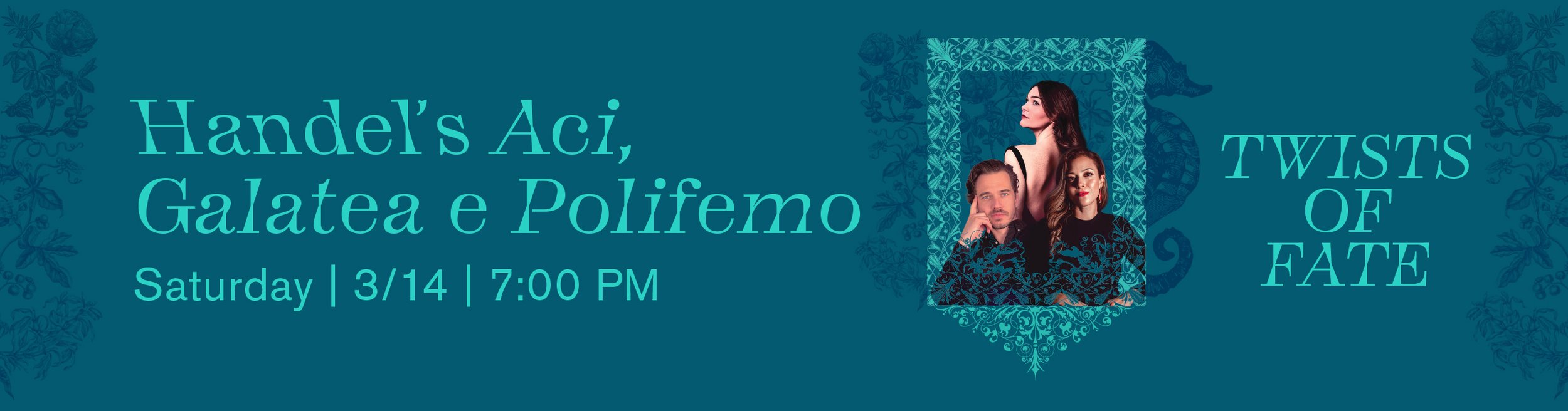
Lauren Snouffer, Aci
— underwritten by Kevin Topek & Mindy Vanderford
Cecelia McKinley, Galatea
— underwritten by Robert Chanon
Douglas Williams, Polifemo
— underwritten by John & Monica Santarelli
This program lasts approximately 2 hours, including one 20-minute intermission. All texts are projected in English surtitles.
Explore the full 2025/26 season here.


-
What is a serenata? Over the years Ars Lyrica has performed a few of them and recorded one: Johann Adolph Hasse’s Marc’Antonio e Cleopatra. Like that work, Handel’s Aci, Galatea e Polifemo has all the musical trappings of Baroque opera, including impassioned dialogue (set simply, as recitative), soliloquies (often in accompanied recitative), and arias that range from tender love songs to raging bravura. But it was first heard in concert, not as a fully staged drama. Serenatas typically have two (instead of three) acts and are often pastoral in nature, with a small group of characters and stories borrowed from mythology or history. They are essentially mini-operas shorn of the usual stagecraft, putting the music-making front and center.
As a young man, Handel spent four years circulating among noble Italian households that favored the serenata for special occasions like royal weddings or births. An impresario-composer could also be expected to hire leading singers plus an entire orchestra for a single performance which often took place outdoors, sometimes with painted backdrops, costumes, and much conspicuous consumption. Aci, Galatea e Polifemo was likely created for just such an occasion, as part of the July 1708 marriage celebrations in Naples of Tolomeao Saverio Gallo, the fifth Duke of Alvito, and Beatrice Tocco di Montemiletto, Princess of Acaja. There is evidence for two subsequent performances as well (for another wedding in 1711 and for a name day celebration in 1713), although neither involved the composer himself.
The story, adapted from Ovid’s Metamorphoses, may seem an odd choice for a joyous occasion: the young lovers Acis and Galatea are threatened by a one-eyed monster named Polyphemus, who aims to destroy their relationship. Besotted with the beautiful Galatea, the cyclops kills Acis with a massive boulder. But the gods intervene, allowing Galatea to transform Acis’s blood into an immortal river. Embracing its depths, she joins him in a watery yet eternal embrace. The obligatory happy ending (supplied by librettist Nicola Giuvo, secretary to the Duchess Donna Aurora Sanseverino, commissioner of the work and the bride’s aunt) resurrects Acis and Galatea, who along with a now sorrowful Polyphemus sing a final trio extolling the merits of true love.
Though rarely heard, this score offers extraordinary musical riches for three sharply drawn characters and a colorful orchestra of strings, winds, and continuo players. Handel depicts the mythical monster especially with great flair. This role requires an enormous vocal range (two and a half octaves) for music that careens from swaggering braggadocio to abject sadness; there’s even a poignant moment at the end where Polyphemus narrates, with palpable regret, Acis’s dying lament. Acis and Galatea emerge as somewhat more conventional pastoral creatures, though Handel endows both with distinct and nicely alluring personalities. Their arias are full of naturalistic imagery: birds and breezes, streams and rivers, all cleverly realized by a young composer obviously enthralled by Italian culture and its rich vocabulary of musical imagery.
Returning to this tale in 1718, Handel created the beloved English masque Acis and Galatea for the Duke of Chandos at Cannons, a grand estate just outside London. Remarkably, this second setting (staged by Ars Lyrica in 2013) recycles none of the material from the 1708 serenata, perhaps because of the limitations of the Cannons musical ensemble. In 1732 Handel made a hybrid version of both works, with some sections in Italian and others in English, mostly to forestall unauthorized performances in London of the 1718 masque. Revived multiple times during his lifetime, this final version is today regarded as inferior to the two earlier works.
© Matthew Dirst