

Fatal Attractions
Saturday, February 14, 2026 at 5PM
Duncan Recital Hall, The Shepherd School of Music at Rice University
(6100 Main St., Google Maps)
In their original context, French solo cantatas indulged literary-minded listeners with venerable tales of love affairs that typically end badly. A vital element of French salon culture in the decades around 1700, these petits tragédies brought leading singers and composers into influential households.
Leander and Hero, who struggle against class and geographic barriers, found a champion in Louis-Nicolas Clérambault, master of the French cantata. Orpheus and Euridice, whose tragic separation inspired countless operas, gave the young Jean-Philippe Rameau similarly juicy material for his first dramatic work. Decades would pass before he found his true calling as a composer of music for the stage.
Featured artists:
Nola Richardson, soprano
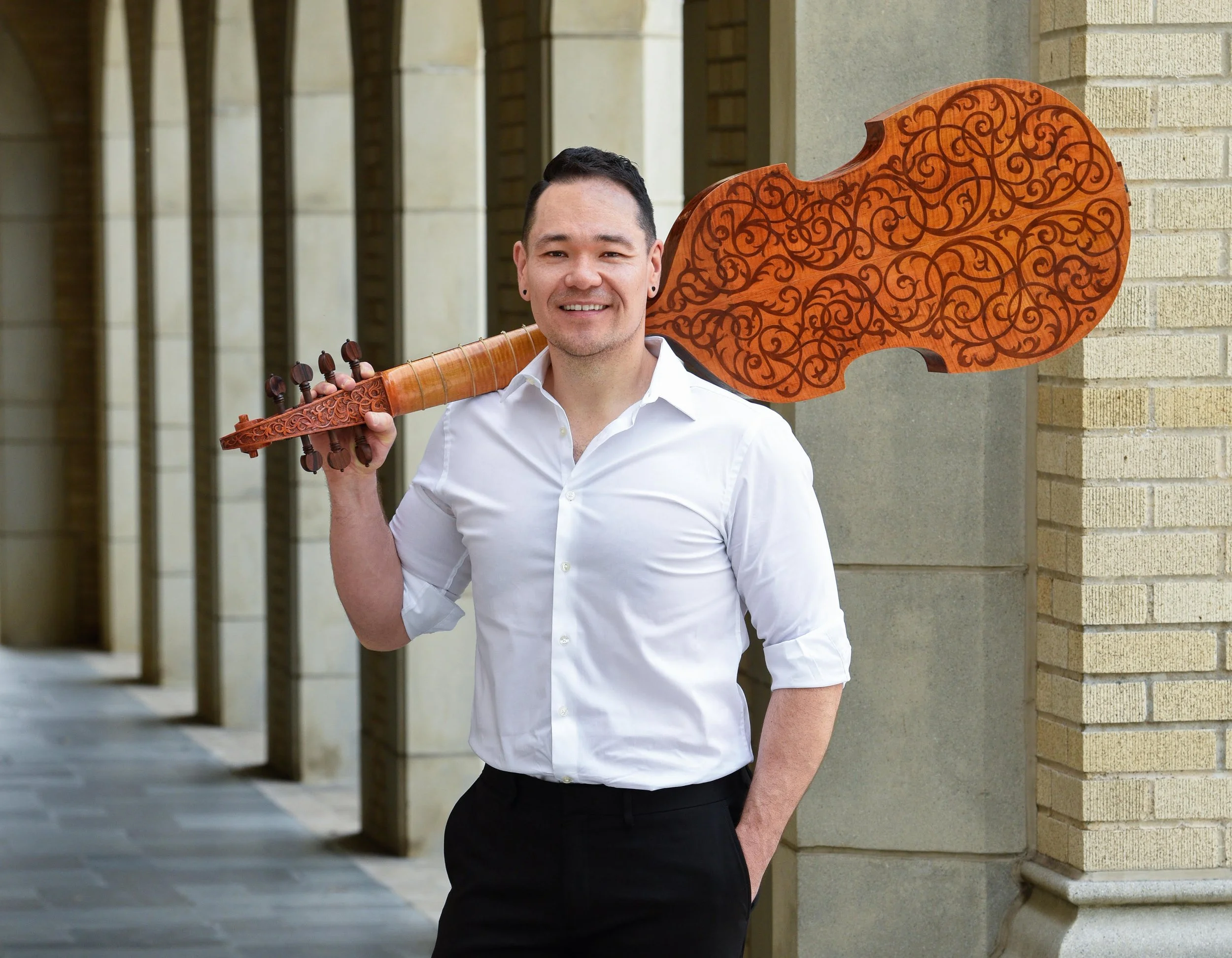
Eric Taeyang Mun, viola da gamba
Carla Moore, violin
On the program:
Louis-Nicolas Clérambault, Léandre et Héro
Jean-Philippe Rameau, Orphée
Explore the full 25/26 season here.



-
When first introduced in Paris around 1700, the cantata was part of a larger craze in France for all things Italian, from sonatas to silks. Unlike opera, likewise an Italian import, the cantata offered economical musical entertainment for aristocratic and royal households, where highly refined chamber music—performed by the era’s finest musicians—had become part of the daily routine. Cultivated until the eve of the Revolution, the French cantata attained a level of prestige comparable to that of its Italian antecedent, which flourished in similarly exclusive environments.
The typical Baroque cantata, irrespective of language or national tradition, comprises three to five paired recitatives and arias whose texts tend to come from mythology or history. Many offer a moral as well, thanks to frequent third-person narration in the libretti. In France such pieces nearly eclipsed opera in popularity during the long sunset of Louis XIV, due perhaps to a waning of the royal attention span; composers of this generation especially cultivated the genre with gusto, producing volume after volume of cantatas. Some of the better works blur creatively the typically distinct textures of recitative and aria, so that one finds arias with recitative “interruptions,” or recitatives with suddenly melodic (aria-like) moments.
As happens in opera, both voice and instruments respond to the expressive ideas in cantata libretti, which may veer dramatically from one emotion to the next or indulge at length a particular state of mind. Sébastien de Brossard, a first-hand witness to this phenomenon, further observes that the cantata often appropriates the orchestral effects of opera, despite the former’s modest resources. In such works the instruments supply for the ear what the eye may miss, conjuring drama exclusively through sound. A musical “tempest,” for example, figures prominently at the crucial moment in Louis-Nicolas Clérambault’s Léandre et Héro (1713). Hero, a virgin priestess of Aphrodite, lights a lamp nightly to guide her lover Leander across the Hellespont (a.k.a. the Dardanelles, which links the Aegean and Mediterranean seas), but one evening a violent storm extinguishes it.
Deprived of his beacon across the water, Leander loses his way and drowns. Jumping from her tower into the waves, Hero joins her lover in death. In a rare display of mercy, Neptune reunites Leander and Hero in eternity to preserve their demonstration of fidelity in adversity. Clérambault’s cantata appends to the standard myth an additional plea to Cupid, to “no longer allow caprice to determine your favors.” As such, this cantata must have made for an interesting entertainment in the apartments of Madame de Maintenon, the King’s second wife and former mistress, who supported Clérambault and hosted performances that Louis often attended.
The other cantata on this program takes as its subject matter a story that has inspired countless art works in various media. As related by Ovid (among others) in the Metamorphoses, Orpheus has gone to the underworld to reclaim Eurydice, his bride. Moved by his mournful plea, the guardians of Hades agree to allow Eurydice to return to life but on one condition: Orpheus must not look back at her until they are safely beyond hell’s gates. Overcome with emotion, Orpheus fails this crucial test and loses Eurydice for a second (and final) time, not for lack of love but for a wobbly spine.
Among the many pleasures of Jean-Philippe Rameau’s Orphée (c1721) is a remarkable central aria in multiple sections, which relate Orpheus’s increasingly desperate state of mind while on his way out of the Underworld. Its final aria, which supplies a moral for the story, has not always been treated kindly in the musicological literature, with one biographer complaining that it lacks empathy. But the tension between impatient desire and tactical success drives the plots of many an opera or cantata. Such choices, as the lives of the rich and famous continue to demonstrate, are endlessly fascinating—and endlessly fraught.
§ § §
Between these “bookend” cantatas, this program also offers diverse instrumental works from the same milieu. On the viola da gamba, the noblest member of the viol family, Antoine Forqueray had few peers. At the age of ten he found a benefactor in Louis XIV—who, after personally funding the young Antoine’s musical studies for a few years, appointed him to the royal chamber ensemble. Celebrated for his “devilish” viol playing, Forqueray maintained an equally tumultuous private life: evidence of his abusive nature includes the imprisonment of his own son Jean-Baptiste by letter de cachet, an arbitrary means for “disappearing” people under the ancien régime.
Following the elder Forqueray’s death in 1745, this same son published a few dozen of his father’s viol pieces, presumably representing the best efforts of a prolific composer. La Mandoline alludes (as its title suggests) to the mandolin, a small but potent plucked string instrument, while La Buisson likely takes its name from a contemporaneous Parisian harpsichordist, René du Buisson. Both follow the popular rondeau format, in which a tuneful refrain played at the outset alternates with new material at regular intervals.
Thanks to a 1724 royal privilege for engraving music, Joseph Bodin de Boismortier became a celebrated composer and publisher of his own work. The former license, granted only to those with good connections at the French court, proved quite lucrative: Boismortier made a considerable fortune with accessible music of many kinds, including sonatas, suites, cantatas, ballets, and at least one opera. Author of an early instruction method for flute, he composed numerous works for the instrument, including six suites that may be played (as the composer explains) without the basse continue—as unaccompanied flute music. His Suite in E Minor, Op. 35/1, begins with a tender and decorative Prélude followed by a spry Allemande. Later movements include two with allusive titles: a gentle rondeau called Les Charités (“Acts of Kindness”) and a lively gigue named L'Emerveillée (“The Enchanted One”).
Élisabeth-Claude Jacquet de la Guerre made a name for herself as a child at the Sun King’s court, where her harpsichord playing made such an impression that her subsequent education was supervised by Madame de Maintenon. Following her marriage to organist Michel de la Guerre, she organized and ran one of the most distinguished musical salons in Paris. Her first publication, a 1687 volume of harpsichord music, led to larger compositions in virtually all genres, from sonatas to at least one full-length opera. The sonata on this program, from a 1707 set of six such works for violin and continuo, features multiple contrasting sections, some of which incorporate popular French dance rhythms like the gavotte or gigue. One other surprise awaits in her Sonata in D Minor: its Aria, premised on a repeating “ground-bass” pattern, expands into a trio texture in a few spots, as the viola da gamba harmonizes seductively with the violin above the basso continuo.
© Matthew Dirst


